Honeycomb House
An artist’s observatory at the edge of the world — the first structure you meet after rounding the southern tip of Africa. A 48-square-metre vessel at the hinge of two oceans, drawn to the confluence by the shifting tones of the sea and the elemental lightness of the stars.
“Trust the data, but expect the outlier.” Field Notes · Cape Cache
Drawn to the edge of the continent
There is a specific gravity to the southern tip of Africa. At the edge of the continent you are pulled by the promise of the Indian Ocean rounding the corner, the quiet solitude of the Atlantic before the two waters merge to pour away into an infinite night sky.
The structure stands on a sloping fynbos hillside above this confluence, floating on timber posts so the dune system continues to breathe. It is an observatory — calibrated to the immense elemental meeting of two oceans.
Below at Rasperpunt lie the stone tidal traps built by early Khoisan communities in the Late Stone Age — walls on the reef that catch fish as the ocean withdraws, as they have for a thousand years. The Honeycomb keeps them in view: a contemporary newcomer in the company of much older, revered structures, grounding the occupant in deep time.
A vessel to sail the vastness
The compact 48-square-metre interior is an exercise in calibration — not minimalism for its own sake, but a vessel sized precisely to the vastness outside. Drawing on the subjective aesthetics of a yacht, the cabin holds everything it needs and nothing it doesn’t, so that the confluence beyond the glass becomes the primary room.
Sloped birch-ply ceilings follow the roofline like a cabin canopy, while a galley kitchen with sustainable wood countertops extends the nautical rigour into daily life. Outside, a sheltered 24-square-metre rear deck extends the living space away from the prevailing wind, while the exterior wraps the primary volume in vertical timber and smooth cement board.
Calibrated to the light and the stars
The signature that gives the structure its name is the hexagonal skin on the ocean facade — a geometry drawn from the fynbos, the barnacle’s plates, and the tessellation of the horizon. Cast by hand and laid across the elevation, the modules shift with the coastal light throughout the day, making the exterior a living surface that tracks the sun’s arc over the confluence.
But the observatory is equally an instrument of the night. The front window is set to frame the Southern Cross — you look straight at it. Far from the light pollution of the mainland, the Milky Way is a visible structure and the Cross a navigation mark rather than an abstraction. The sculpture on the walls and the bespoke finishes throughout are the artists’ own practice, dissolving the boundary between the art made in the studio and the space lived in under the stars.
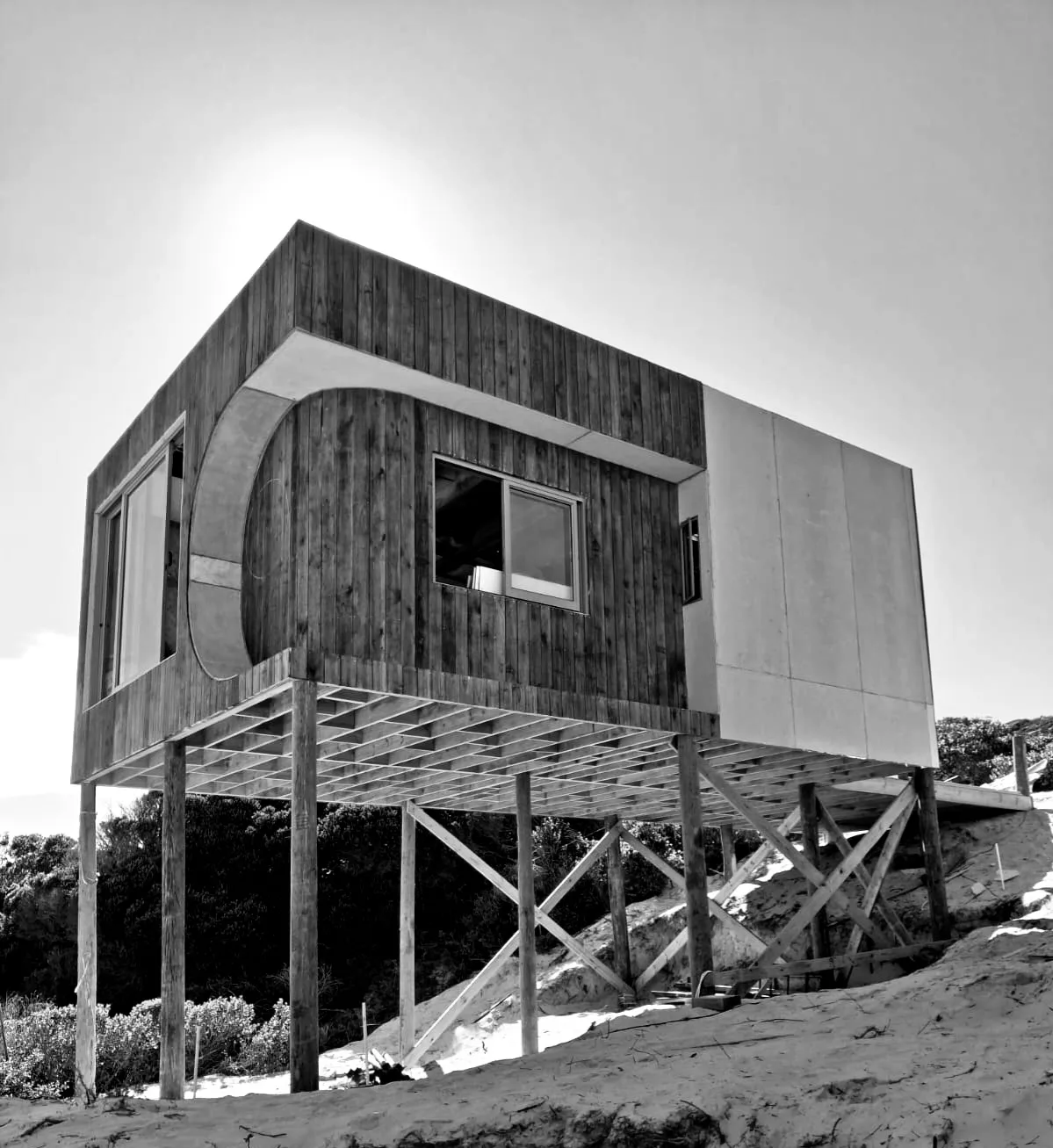
On the dunes at Suiderstrand
The Honeycomb House,
Suiderstrand, Cape Agulhas,
Western Cape, South Africa
- Setting
- Dune overlooking the southern tip of Africa
- Getting there
- From Cape Town via the R43 to Elim, then the coastal road (±2½ hrs)
- Structure
- 48 m² interior · 24 m² deck · elevated timber · HIVE GFRC skin
From time to time, the house receives guests
The Honeycomb is first the artists’ own observatory. When the studio keeps them elsewhere, it receives a small number of guests — an invitation to step into the instrument and watch the sea change colour on the horizon, the light shift register with each headland, and the Southern Cross wheel overhead. Stays are few, and arranged personally.
The working studio at Pearly Beach receives guests by appointment.