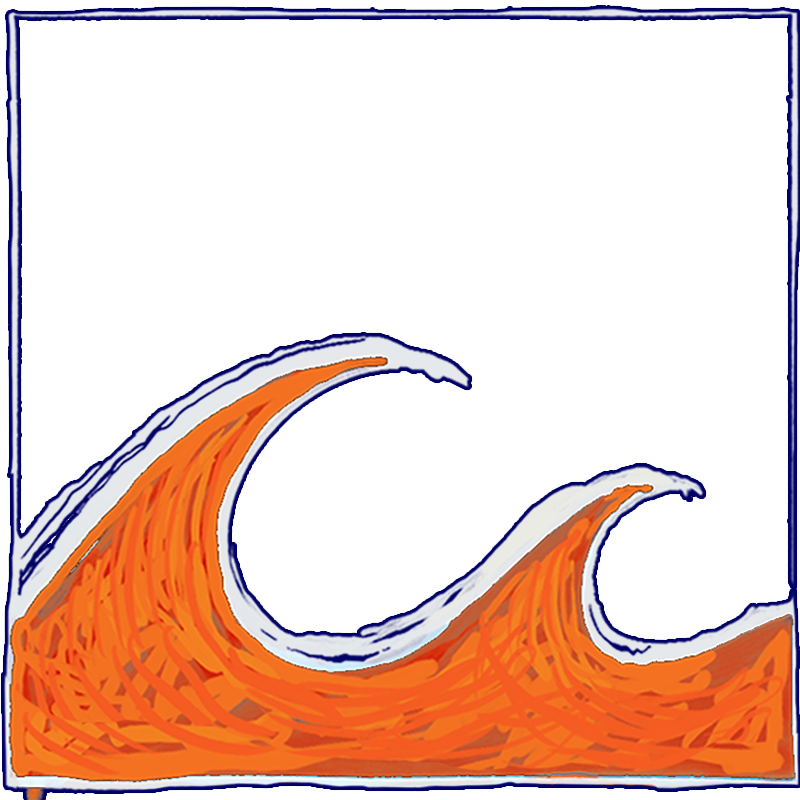

The Specimen, 1993 — fish skeleton on a dark ground; the diploma work, signed Fouché Hough ’93. The paint was the first specimen.
Artist Statement
Ché Hough · Studio PracticeA museum specimen is a thing taken — killed, preserved, labelled, owned. My specimens are remembered — created in a non-toxic material as an act of enquiry. The Poetic Taxonomy that follows investigates visible and invisible forces: creatures in a liminal state, velocity, surface tension, the collective energy of the school. A taxonomy of energy, not of objects.
Ché Hough (born Fouché Hough; b. 1971, Cape Town) lives and works in Pearly Beach on the southern tip of Africa. The practice begins in 1993 with the painting above — a fish skeleton made for his fine art diploma after an internship at the East London Museum, where his taxonomic gaze was trained. A maritime career spanning twenty-five years followed, covering 139,500 nautical miles at sea. He reimagined the skeleton in three dimensions, shaped by hand from water-based resin — a Dutch composite that is, conceptually and chemically, VOC-free. The work strips away the flesh to study the underlying structure: the lattice of bone that remains.
Poetic Taxonomy
Reading the OceanA natural-history museum classifies; a sculptor interprets. At the southern tip of Africa the studio reads the ocean the way a navigator reads water — for the patterns beneath the surface — and translates those patterns into sculptural anchors for the modern interior.
The work is held as six such taxonomies — The Specimens, The Entanglement, Surface Tension, The Collective Body, The Invisible Law, and The Habitat — each a different way of reading the sea, each producing objects designed to alter the resonance of the room they enter.
The taxonomies are poetic rather than scientific: they do not claim to be Linnaean. They are the studio’s own attempt to name the forces it keeps encountering — the skeleton beneath the flesh, the ghost gear that outlives its purpose, the liminal moment at the waterline, the wisdom of the group, the invisible law that orders the wave and the shell, and the human habitat that receives the work. Each taxonomy is a lens, and through each lens a different kind of object comes into view.
Materials
Clay, Composite & RopeFor the large-scale skeletal forms, the studio’s primary medium is A1 (Acrylic One) — a Dutch two-component composite of mineral powder and water-based acrylic resin. Clean air, deep light, and a material strong enough to carry the presence of a three-metre skeleton without the weight of stone.
Beyond its engineering advantages, the material offers a quiet conceptual resonance: a historical Cape lineage, shaped by the Dutch East India Company, is now cast in a modern Dutch composite that is, quite literally, VOC-free.
Rope — Reclaimed & Harbour
Two kinds of rope, two kinds of alchemy. The first is gathered strand by strand from the tideline at Pearly Beach over years — the colours are whatever the sea handed over, and once the rope is bound into a form, it is out of the water for good. The second is working gear: industrial mooring rope, commercial longline, the line that outlives the vessel it served and then outlives its second life in the sea. One colour — the salt-faded grey of gear that has done its work — bound into a tail that remembers the creature it was taken from.
Both are materials that have already survived something. The studio does not restore them to their original use; it gives them a second purpose, and in doing so asks whether the burden of entanglement can become the thing that holds a room together.
The Studio as Exposure Site
At Pearly Beach, where the wild Southern Ocean brings its weather straight from Antarctica, the studio itself functions as an exposure site. Surfaces are read the way a deck is read — for weathering, salt, ultraviolet light, and time. The coastal landscape is not only the subject of the work; it is a collaborator in its finish. Every piece that leaves the atelier carries the trace of this coast.
The Frame
Stripping away the noise to find the underlying structure. In a world of overwhelming complexity, these suspended skeletons are exercises in absolute clarity — the essential truth of velocity, without the distraction of the surface.
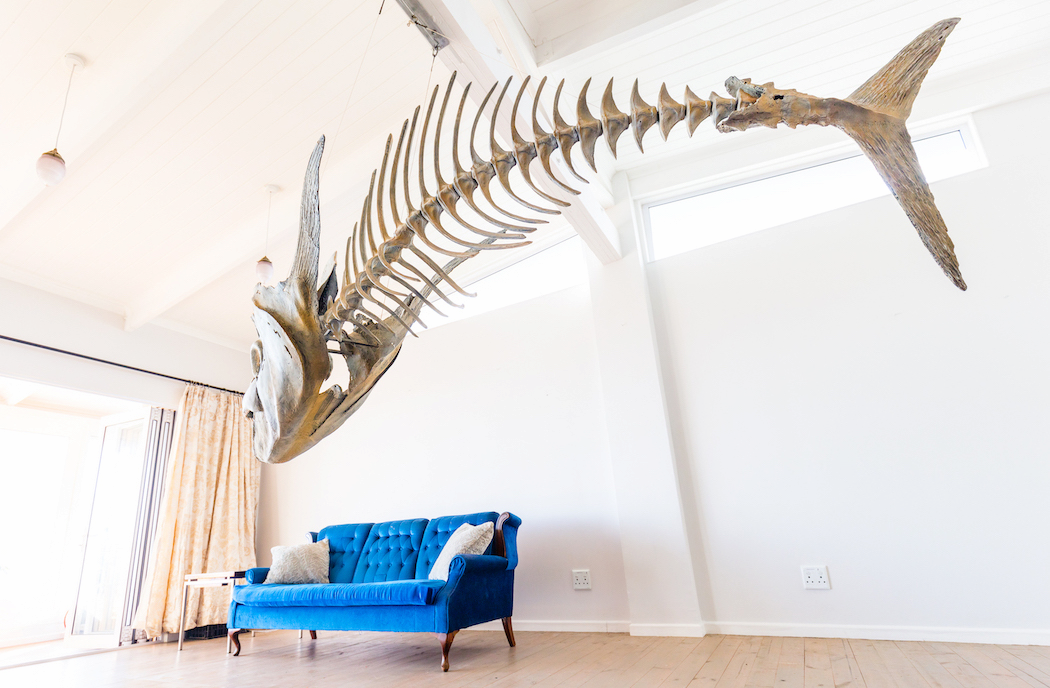
Anatomy of Velocity
The Frame — The Architecture of SpeedStrip away the flesh and what remains is the essential truth of velocity — the spine as thrust, the ribs as a cage, nothing extra. Suspended from a single line, the skeleton resizes the room around it: the ceiling becomes surface light, the floor becomes depth, and the vast space becomes oceanic. It casts a shadow that travels with the sun, so the piece never moves yet never looks the same twice.
The collectors who commissioned Bone had a triple-volume space filled with extraordinary pieces but nothing to hold it. After the skeleton hung, every other piece gained greater clarity and uniqueness. A room-sized anchor for the room that has everything except the thing that holds it all together.

Anatomy of Velocity II
The Frame — The Grammar of the AmbushThe stillness that holds a strike. Where the tuna mirrors endurance, the snoek mirrors decisiveness — the exact geometry of a moment when preparation becomes action. Three metres, every bone formed by hand. The skeleton doesn’t record a migration; it records the exact geometry of a strike.
Suspended in the Dallas Smith Gallery’s double volume, it became the piece every visitor stopped beneath — the conversation piece that anchored the room. It is a piece for the space that needs an anchor, a meeting point, a reason to look up.
The Entanglement
The art of turning what harms us into what holds us. Reclaimed ghost gear and harbour rope — unknotted, cleaned, and reformed into a structure of grace. Each piece is a quiet testament: the belief that our deepest entanglements and heaviest burdens can become something that anchors a room.

Ghost Tide
The Entanglement — The Precursor, 2022The first thing the studio made about entanglement — before the practice had a name. Cold aluminium, a dolphin caught mid-struggle in netting toward the surface, the shine already leaving the metal. It is the grief that precedes every act of alchemy in the work that follows.
It stays in the studio because some witnesses cannot be sold — they have to keep speaking.
One of a kind · Not for sale

Ghost Tales I
The Entanglement — The Collected RopeEvery strand was pulled from Pearly Beach over three years — washed, hand-bound into a form that remembers the creature it was taken from. The colours are whatever the sea handed over; the alchemy is the binding. Once the rope is in the tail, it is out of the water for good.

Ghost Tales: The Harbour Line
The Entanglement — The Industrial RopeThe same alchemy, at the scale of the harbour. Industrial mooring rope, commercial longline — the working gear that outlives the vessel it served, then outlives its second life in the water. One colour: the salt-faded grey of working gear, bound into a tail.
Shown: one of a series of unique works in reclaimed harbour rope
Surface Tension
The liminal waterline — the exact moment a body breaks the surface. The shark’s ancient focus, the dolphin’s hydrodynamic grace, the flying fish that becomes free in the very act of trying, and the whale’s resonant breach — not explosive, but the orchestra filling the silence.

Apex Silhouette
Surface Tension — The Ancient FormA quiet intensity of ancient focus. The shark is one of the ocean’s oldest forms — a creature that has evolved over millions of years into exactly what it needs to be, nothing wasted, nothing extra. For a water person, an encounter with a shark is not fear but a held-breath, awe-inspiring moment: sublime concentration, pure intent, the top predator at the exact peak of its evolution — the fin cutting the surface, the body etched with the hydrodynamic flow that has carried its lineage through deep time.
Shown: Forma Antiqua — no two cast the same

Kinetic Dolphin Dorsal
Surface Tension — DirectionThe exact instant before the leap — direction, not yet action. The dorsal fin imagined in the hydrodynamic flow that will carry it through the surface. Cast in brass verdigris, deep bronze, or a vibrant polychrome, whichever the piece asks for; the studio doesn’t repeat a surface because no two leaps are the same.
Shown: Cerulean Flow — the studio doesn’t repeat a surface

Kinetic Dolphin Tail
Surface Tension — The Moment AfterPropulsion, not signal. The moment after the dorsal — the force behind the direction. Complementary to the Dorsal as intention is complementary to action: one shows where, the other shows how.
Shown: Graphite finish — each piece cast and etched once

Piscis Volans
Surface Tension — Becoming FreeIn the process of trying to be free, the fish becomes free. Flying fish don’t fly for grace — they fly because predators wait below. But in the suspended second where the wings lock wide and the tail-beats skim the froth, survival becomes flight. The graceful escape that was meant to save its life becomes the thing that fills it with freedom.
Jacques Derrida wrote: “To pretend, I actually do the thing: I have therefore only pretended to pretend.” The fish pretending to escape is, in that instant, simply free. The only piece in Surface Tension that looks back — rendered in copper with hand-applied verdigris, the colour shifting toward the wingtips into the same blue-green the metal forms wherever it meets salt air.

Cartography of a Breach
Surface Tension — A Reading Drawn OnceThe fluke stays the same every time; the map drawn onto it changes — contour lines charting exactly how that particular breach moved, by hand, once.
At scale, the piece anchors the room and harmonizes it: a large form that brings a deep, resonant calm to the space it enters.
Shown: Catalogue No. I — painted once, never repeated
The Collective Body
The wisdom of the group. In a world that demands we face everything individually, the school offers a different architecture: shared resilience. The burden of the edge is rotated, the risk is distributed, and the collective mind outsmarts the predator. These works are for the spaces where we remember we do not have to carry it all alone.

The Sardine School
The Collective Body — The Running SchoolWhat moves together, survives together. A running school reads as a single silver shadow that, up close, dissolves into a hundred thousand fish. The panel is the unit; a current of panels is the migration.
In graphite the fish carry their own flash; in verdigris the copper bodies weather like water. Known in the studio, without much ceremony, as Bubbles & Co. — a modular work for walls that want to remember that survival was never individual.

Sagax — The Bait Ball
The Collective Body — The RotationA bait ball isn’t a hiding place — it’s a rotation. Each fish takes its turn on the exposed outer edge, then cycles back to the protected centre. The risk is shared because the positions never stop moving. The name is the fish’s own: Sardinops sagax, Latin for wise, quick to perceive.
The full sphere holds 133 sardines; this panel is a partial configuration, built to join edge to edge into a whole wall of fish.
The Invisible Law
Finding the pattern in the turbulence. These pieces translate the invisible forces that shape the sea — wind scales, the Fibonacci spiral of a breaking wave, the grown-law spiral of a shell — into navigational order. They bring a sense of deep, readable wisdom to a room, transforming chaotic energy into clarity.

The Beaufort Scales
The Invisible Law — What the Wind Does to the WaterBeaufort’s scale doesn’t measure the wind; it measures what the wind does to the water. Each disc translates that reading into volumetric depth and hand-drawn cartographic isobars — the wisdom of navigational order brought into a room.
Shown: Force 4 — the scale runs 0 to 12, each disc unique

Fibonacci’s Back Door
The Invisible Law — The Formed-Law WaveTaking the moment as it comes. The Fibonacci sequence — the golden ratio written into the spiral of a breaking wave — and the surfer’s backdoor, the entry from an unconventional angle. What looks like arriving late is sometimes exactly what leads you into the barrel of the wave.
The wave’s curving form carries the mathematics of beauty, and the backdoor is the practice of staying open: trusting that the unexpected entry is sometimes the true one. A piece for the spaces where you remember that the best rides of your life didn’t come from the path you planned.

Midden
The Invisible Law — The Grown-Law SpiralEverything has an underlying structure; time is what reveals it. The midden fragments have been weathered away to expose their core architectures — the grown-law spiral, the limpet’s radial web, the nautilus’s chambered curve. A practice of minimalism: what is removed matters as much as what remains.
One unit reads as a single relief; tessellated across a wall, they become a screen that shapes how light and sound move through a room — like a Buddhist sand garden, where the pattern drawn in the sand is a daily practice of finding the essential form beneath the surface. Three readings: Radial, Spiral, Helix — each one a meditation on what survives when the noise has worn away.
Shown: Helix — one reading of three (Radial · Spiral · Helix)
Habitat
The same coastal logic, applied to the spaces we inhabit. Vessels, surfaces and architecture — functional sculpture cast from hand-sculpted masters, made once.
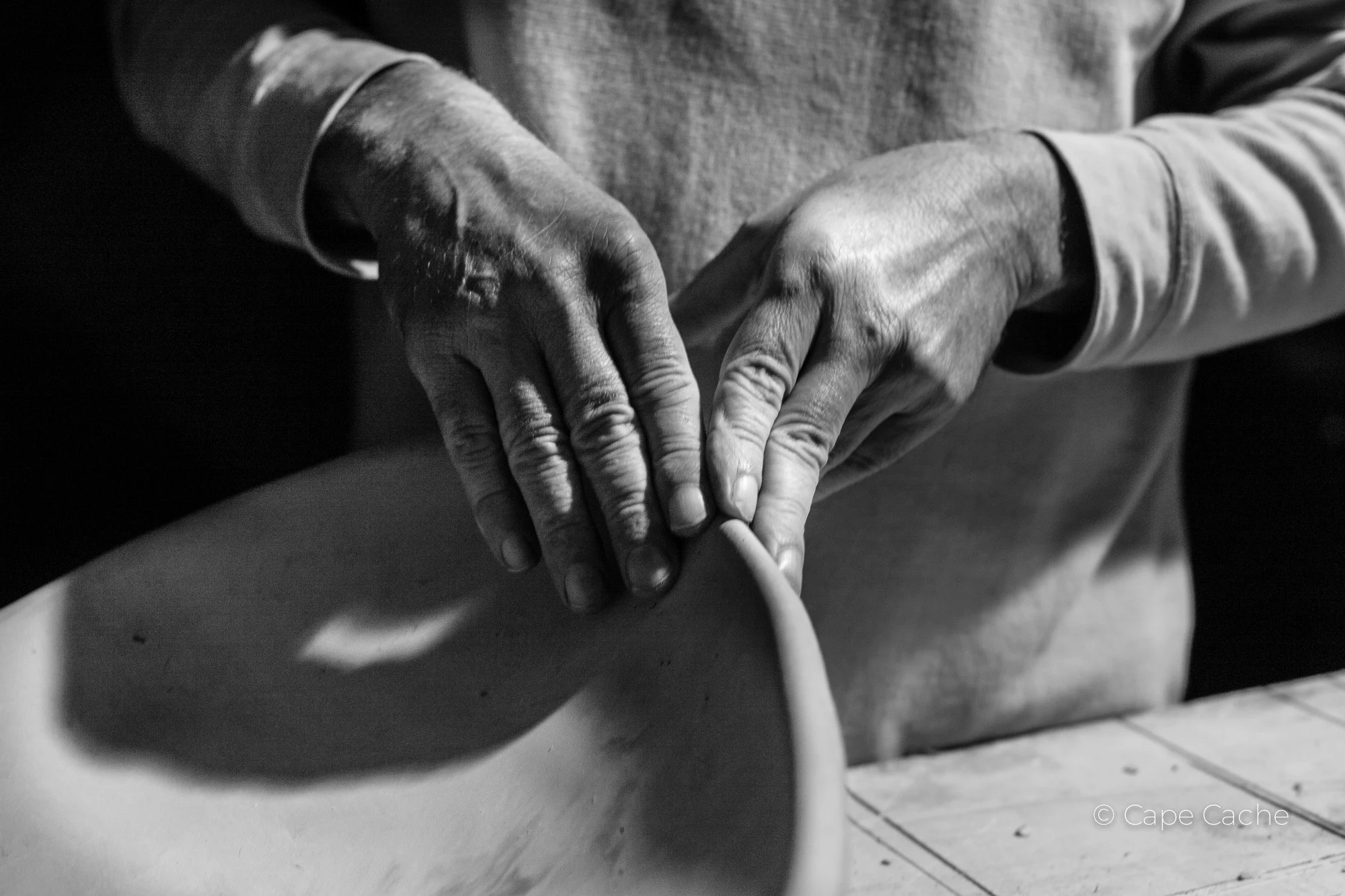
Elemental Vessels
Habitat — Functional SculptureA basin that is also a sculpture; a light that is also a form. Basins, lights and vessels at the scale of a room, each cast and fired individually from a hand-sculpted master.

Tiles
Habitat — Tactile TectonicsHand-cast GFRC and ceramic for the wall — HIVE, the hexagonal module, and Singular, the tile made once. The same coastal logic, applied to the surface that faces the weather.
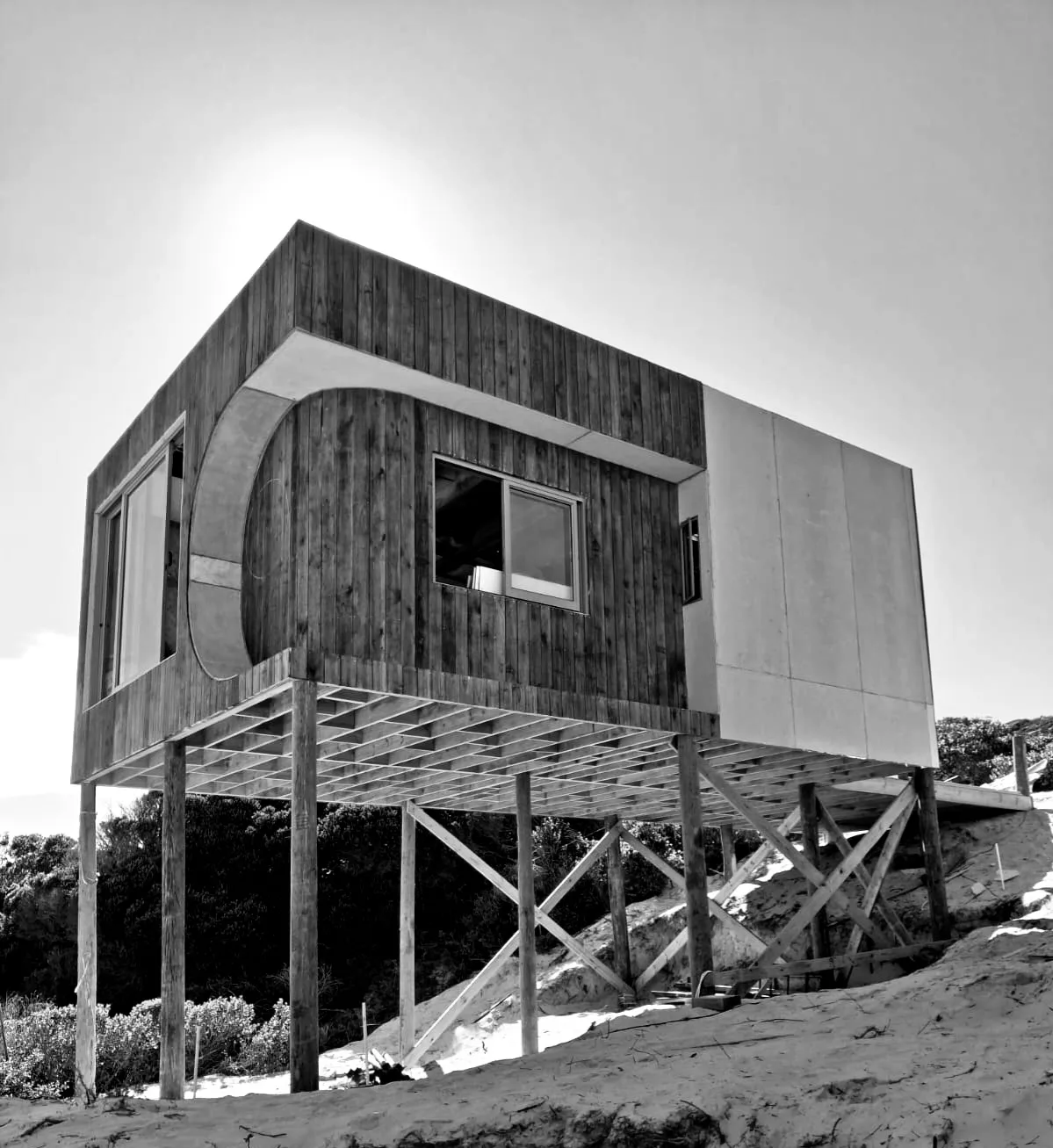
The Honeycomb
Habitat — Spatial InterventionHIVE at the scale of a home — the module becomes architecture. A residence in Suiderstrand wrapped in the honeycomb, with suspended sculpture within.
The same coastal logic extends to the wall and the vessel — HIVE and Singular, and Elemental Vessels.
Commission a Work
Site-specific commissions begin with your space — its light, volume, and silence. From there, the form finds itself.
Begin a conversation