Hive
The elemental coast, cast in concrete. A wall — facade or interior — that keeps the rhythm of shadow and light.
The Story
HIVE is a cast, not a found fragment and not a printed pattern — a single hexagonal module in lightweight glass-fibre reinforced concrete, made to be accumulated across a wall the way a reef accumulates across a rock. Light enough to climb a wall, dense enough to face the weather.
The hexagon is the coast’s own tessellation — the coral’s calyx, the barnacle’s plates, the cemented honeycomb of the Sabellaria worm along the False Bay shore, the hexagonal aragonite the abalone lays down as nacre, the comb of the fynbos bee. HIVE casts their answer in concrete. And it is self-similar — one rule in three registers: the hexagon that orders the wall, bounds the tile, and textures its face.
On a wall, the relief moves to the rhythm of shadow and light. Light on the rim, shadow in the channel, turning with the sun — the wall keeps the rhythm of the coast, hour by hour, season by season. A flat facade is a blank the eye slides past; a HIVE field is a surface the light reads.
Where It Lives
On the outside of Honeycomb House at Suiderstrand, where it was first deployed as a honeycomb skin to modulate the sun and break the scale of the elevation. On a covered veranda or a garden boundary wall, where the relief catches the late light. Around a pool, on the return wall of a courtyard, across the facade of a boutique hotel or a restaurant vestibule. And inside — as a feature wall behind a hearth, a textured plane in a circulation corridor, a hard surface given enough relief to soften the acoustics of a room. Because the module is cast in exterior-grade, lightweight GFRC, the same commission can wrap from the weather face of a building to its quietest interior without changing its language — everywhere, the wall moves to the rhythm of shadow and light.
“The wall moves to the rhythm of shadow and light — the rhythm of the coast, kept in concrete.”
The Module · One cell
Hive

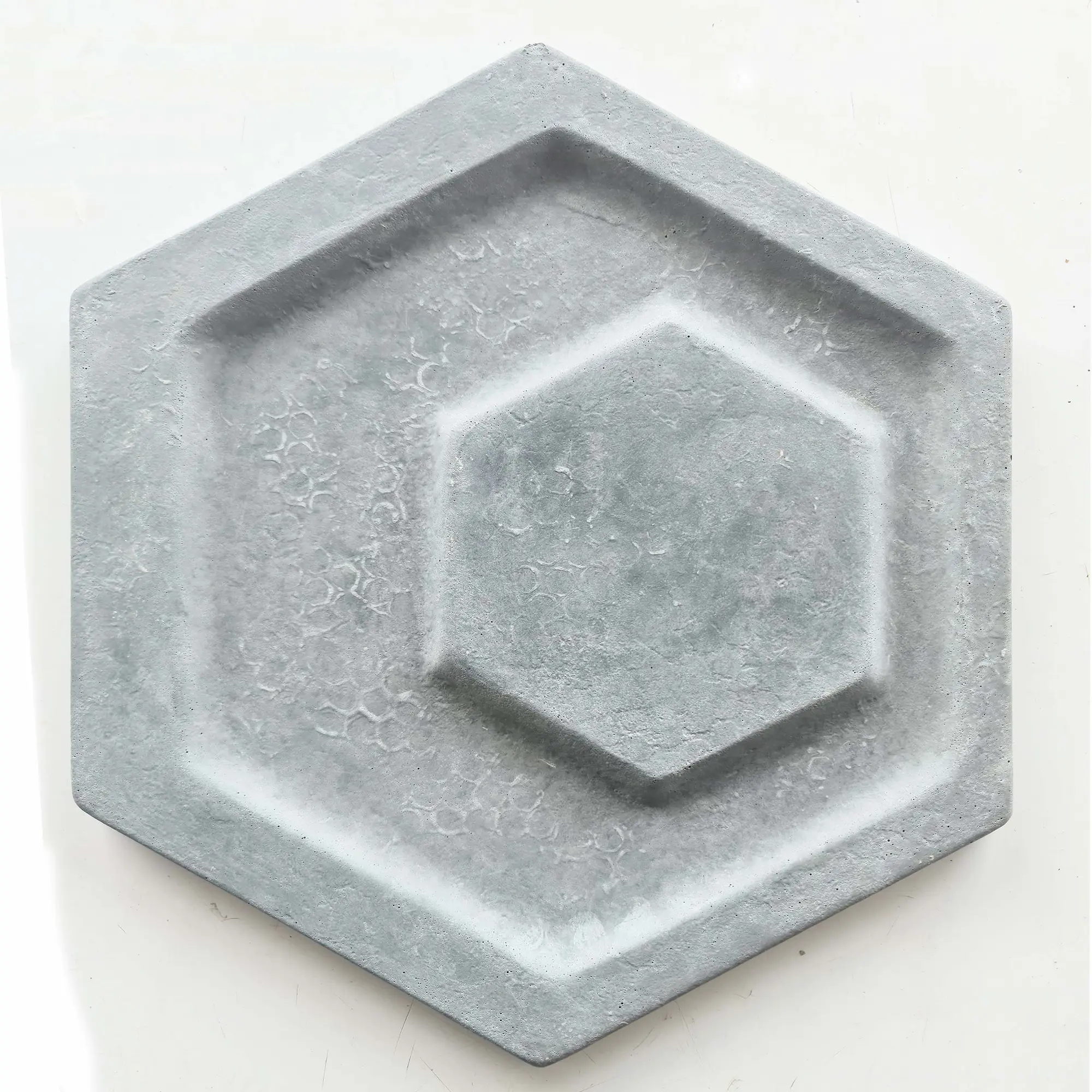
One hexagon in one size — the whole system is this single cell. In section it is a small piece of architecture: a raised rim, a recessed channel that holds the shadow, and a raised heart — the calyx the polyp built and the cell the bee capped, as a step down and a step up in concrete.
The heart is set off-centre, and the offset is the whole point. A centred heart makes a pattern. An off-centre heart makes the rhythm of the coast — each cell carries a subtle lean, a direction, so the field reads as a reef: ordered, but never gridded. It is what the coral does: the polyp builds its calyx to the light and the current, not to a centre point. HIVE inherits the same bias. The asymmetry is not a tolerance or an error; it is the design’s signature.
The recessed bed is left un-smoothed: a finer honeycomb is impressed into it while the cast is green, so the tile is a relief within a relief, and the motif that tiles the wall also textures the tile.
330 × 330 mm · nine tiles to the square metre, laid · raw GFRC shown · finer honeycomb impressed into the bed · patinated to the commission
From Cell to Field
Cell Becomes Comb
A single tile is the cell; laid across a plane it becomes the comb — the thing the word names, a surface built by setting one form against itself until the seams vanish and the wall reads as one membrane. The hexagon is the only regular shape that closes a plane with no gap and no overlap, which is why the bee and the coral both chose it; HIVE inherits the same economy, laid sealed edge to edge into a continuous skin.
The only choice the layout asks is which way the hexagon lies — point-up, so the offset rows read as rising columns, or flat-up, so they read as courses: the same module turned ninety degrees, the wall’s proportions deciding. Run as a full elevation or held to a single band, the field is a made-to-measure commission — patina, orientation and fixing composed to the plane, the layout, weight and lead time worked per site. Each module cast in the Pearly Beach studio; field size specified per project.
Honeycomb logic — schematic, not to scale. The same sealed comb, two ways to lay it: A point-up, B flat-up — the module turned ninety degrees. Explore the orientation, the patina and the lay below.
Explore it below — turn the comb the way your wall wants it, preview the patina, and lay it uniform or hand-finished.
Poetic Taxonomies · Surface · Hive
The Honeycomb
One uniform cell, repeated until the wall becomes a comb. Turn it the way your wall wants it and preview its patina.
Patina is an indicative preview — the real finish is mixed by hand. “Hand-laid” breaks the machine-perfect repeat, tile by tile. Tilt is for composition only; the buildable orientations are point-up and flat-up.
Point up
The hexagon on its point — the offset rows read as rising columns of cells.
Flat up
The hexagon on its edge — the offset rows read as horizontal courses.
An indicative visualisation — orientation and patina are previews; the cast field is mixed and laid by hand, so no two are alike.
Cape Cache · Hive · Honeycomb Studio
Made to order — a bespoke commission, patinated and fixed to the architecture it is made for.
One uniform hexagon in one size; the field is built by repetition, not by varied shapes. A raised rim, a recessed shadow channel, and a raised heart — a relief within a relief, with a finer honeycomb impressed into the recessed bed.
A centred heart makes a pattern. An off-centre heart makes the rhythm of the coast — each cell carries a subtle lean, a direction, so the field reads as a reef: ordered, but never gridded. The asymmetry is not a tolerance or a casting error; it is the design’s signature.
The wall moves to the rhythm of shadow and light — light on the rim, shadow in the channel, turning with the sun. The relief keeps the rhythm of the coast, hour by hour, season by season.
Cast from the coast’s own tessellation — the coral’s calyx, the barnacle’s plates, the bee’s comb — and self-similar: one rule in three registers, the hexagon that orders the wall, bounds the tile, and textures its face.
330 × 330 mm per module; laid, nine tiles to the square metre. Relief depth confirmed on enquiry so the grid resolves cleanly to the plane.
Cladding tile — single cell, accent band, or full honeycomb field; interior and exterior.
Exterior facades and elevations (as at Honeycomb House, Suiderstrand), covered verandas, garden and boundary walls, pool surrounds, courtyard returns, boutique hospitality and restaurant vestibules, interior feature walls, and acoustic softening for hard-surfaced rooms.
Fixed as a tile. For most interior and exterior work the module is set in a standard tile adhesive — the GFRC carries the same fixing logic as a ceramic or stone tile, at a fraction of the weight. Where the wall is in a public space or otherwise legislated to carry a mechanical fix, a separate clip is anchored into the substrate and hooks into a fixing point cast in the back of the tile, with the tile then bedded in adhesive — so the mechanical line holds the tile independent of the bond, and the fixing is redundant rather than relied upon. The method is confirmed per site — the wall, its height and its use decide it, not the tile.
Single cell · accent band · full field, laid sealed edge to edge in one of two orientations — point-up or flat-up — chosen to the wall’s proportions; the joint a fine raked line or a flush grout. Patina, orientation and fixing resolved per site; fixing grid, per-tile weight and lead time confirmed to the commission.
Lightweight GFRC, exterior- and interior-grade, cast from a hand-made original; the recessed bed impressed with a finer honeycomb while green. Light enough to climb a wall, dense enough to face the weather; each surface patinated and coloured to the commission.
Cast in the Pearly Beach studio. A signed certificate of authenticity is included with every commission.
Tracked courier from Pearly Beach, South Africa and internationally. Fixing guidance supplied with every order, the method advised per site; for full fields, layout and installation consultation are provided.
Studio & Production
Ché Hough (born Fouché Hough, 1971, Cape Town; Dutch–South African) lives and works in Pearly Beach at the southern tip of Africa. Twenty years at sea are the field research behind a practice that reads the ocean as a poetic taxonomy — essentially true rather than factually exact. HIVE extends that practice to the scale of the wall, casting the elemental coast into concrete.
- Studio
- Cape Cache, Pearly Beach, Western Cape
- Production
- Each module cast in the studio; field size specified per project
- Module
- 330 × 330 mm hexagon, one size — nine to the square metre laid
- Material
- Lightweight glass-fibre reinforced concrete (GFRC), exterior and interior grade
- Finishes
- Raw GFRC grey (standard), limewash, oxidised, graphite, ochre, or patina mixed to the wall
- Fixing
- Tile adhesive standard; clip and adhesive where legislated; method confirmed per site
- Lead times
- Confirmed per project; studio-scale production allows careful attention to each commission
- Certificate
- Signed certificate of authenticity included with every commission
HIVE is made to order as a single uniform hexagonal module in lightweight GFRC, for interior and exterior walls. We work directly with architects, designers, and private clients to compose a single cell, an accent band, or a full honeycomb field — the patina, the orientation and the fixing method resolved to the wall, its height and its use.
Begin a Commission EnquiryThe same studio also works at the scale of the hand and the room — MIDDEN, cast shell reliefs in negative space: the art made into a wall, where this piece is the wall made artful.